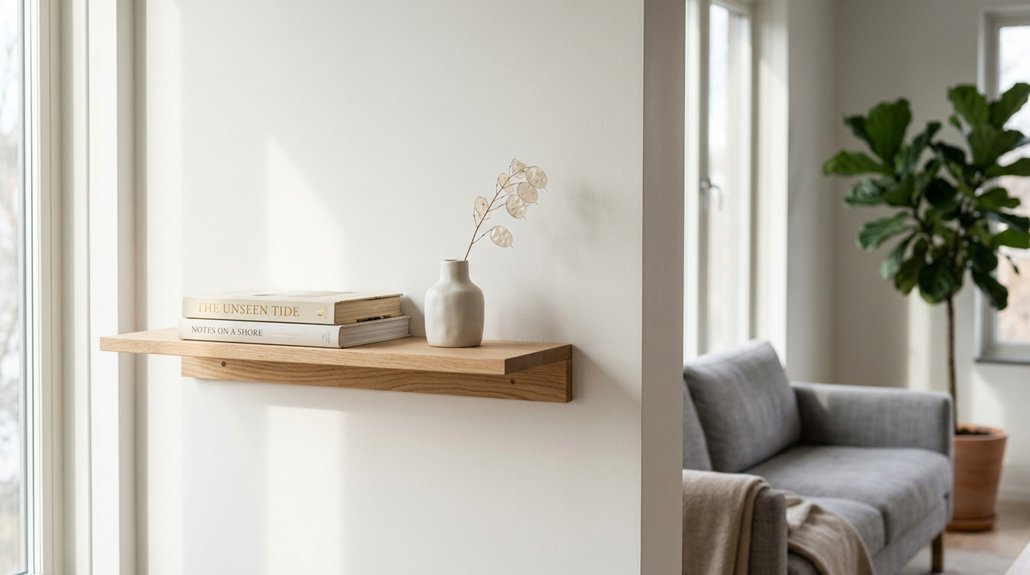
Your floating shelf is a bridge between your walls and your ambitions, but that bridge has load limits you need to respect. A single stud with basic brackets holds roughly 50 pounds, while premium hardware on two studs can support 300 pounds or more.
The real capacity depends on bracket design, rod count, and whether you’ve hit actual studs or relied on drywall anchors. You might think you’re safe stacking books and décor, but without proper backing or distributed mounting points, you’re gambling with gravity.
The difference between a shelf that sags and one that soars comes down to details most people miss entirely.
How Much Weight Can a Floating Shelf Actually Hold?
How much weight you can actually load onto a floating shelf depends almost entirely on what’s happening behind the drywall, and that’s where most people get it wrong. Your weight capacity starts with per-stud capacity, typically around 50 lbs per wall stud for basic brackets, though premium hardware rated at 150 lbs per stud delivers serious gains. Hit two studs properly, and you’re looking at roughly 300 lbs of potential, assuming even load distribution and solid installation technique.
Shelf depth and material won’t budge your per-stud capacity, but deeper shelves extend that lever arm, inviting sag over time without adequate support. Your mounting method changes everything. Two-piece or prong-style brackets can’t match integrated bracket systems, those mortised designs that distribute force across multiple wall studs.
For heavier shelves, stud mounting isn’t optional, it’s essential. Skip the studs, and you’re gambling with gravity.
Recommended Products

✓ HIGH-QUALITY METAL MATERIALS: Our shelf support is made of thick and heavy duty iron materials.Features a thick black matte surface coating that delivers enhanced water resistance and effective anti‑rust performance for long‑term daily use.

【Standard 90° bending】In order to ensure that each shelf bracket can be at 90° to the maximum extent possible, we add a rigorous picking process before the shelf brackets are packaged. The standardized 90-degree design is so important that it’ s the objective factor in ensuring that items remain level and do not tip over after being placed on the board(board is not included).
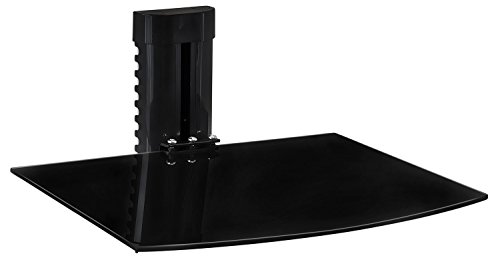
GAME NIGHT, ORGANIZED – Keep your console, streaming box, or cable box right where you need it, off the console table and out of the way, so your gaming corner or home theater setup stays clean and clutter-free.
Why Studs Matter (and What Drywall Anchors Can Really Handle)
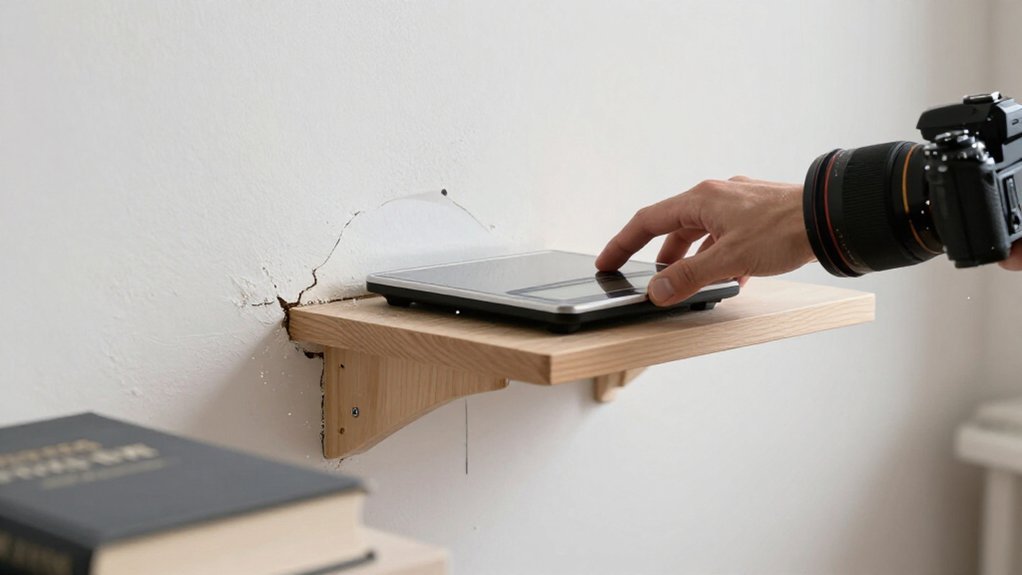
Your floating shelf is only as strong as what it’s screwed into, and that distinction separates a reliable installation from a weekend disaster. When you anchor into studs, you’re tapping into the structural backbone of your wall, and that’s where real weight capacity lives. Most hardware performs at roughly 45–50 lbs per-stud load, so hitting two studs typically yields 90–100 lbs of reliable shelf support.
Skip the studs, and you’re gambling with drywall anchors that simply can’t match that performance. Sure, heavy-duty anchors exist, but they’re backup singers, not the headliner. Proper wall mounting demands load distribution across multiple connection points, and nothing distributes weight like solid wood framing.
If you absolutely can’t find studs, space your anchors carefully and check their ratings, but don’t expect miracles. Your books deserve better than hoping for the best.
Recommended Products

𝐌𝐨𝐝𝐞𝐫𝐧 & 𝐌𝐢𝐧𝐢𝐦𝐚𝐥𝐢𝐬𝐭 𝐒𝐭𝐲𝐥𝐞 - Featuring clean lines and a sleek black finish, these wall-mounted shelves bring modern industrial and contemporary charm to any space. Perfect as shelves for room decoration, book shelves display, and bold dark wall decor — they elevate your bathroom wall art vibe, bedroom aesthetic, living room style, kitchen organization, office setup, and laundry room storage all in one versatile design

Firm & Solid Construction: Our wall-mounted shelf is 430 stainless steel, ensuring durability and easier cleaning. The surface features a brushed treatment, built to resist daily scratches, corrosion, and tarnishing. So don't worry about food and liquid splashes ruining your surface.

𝐌𝐨𝐝𝐞𝐫𝐧 & 𝐌𝐢𝐧𝐢𝐦𝐚𝐥𝐢𝐬𝐭 𝐒𝐭𝐲𝐥𝐞 - Featuring clean lines and a rustic brown finish, these wall-mounted shelves bring warm farmhouse charm and modern style to any space. Perfect as shelves for room decoration, book shelves display, and rustic farmhouse wall decor — they elevate your bathroom wall art vibe, bedroom aesthetic, living room style, kitchen organization, office setup, and laundry room storage all in one versatile design
How Bracket Design Secretly Limits Your Load
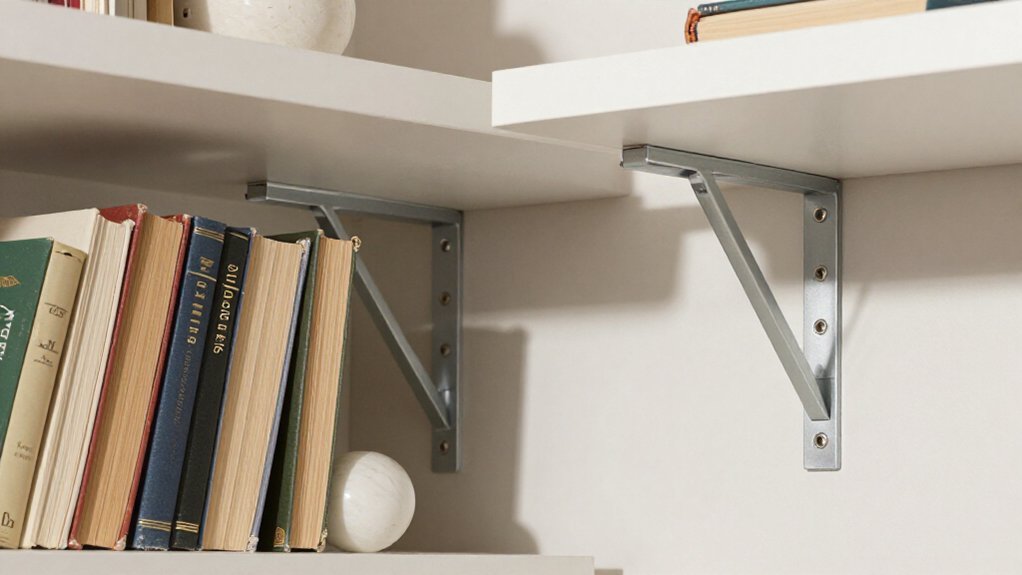
You might assume your shelf’s material determines its strength, but the bracket design actually dictates how much weight you can safely stack. Prong brackets concentrate stress at single points, causing them to bend or pull away under sustained load. Box shelves with two-piece connections often develop gaps or shift unexpectedly. Integrated brackets that span multiple studs distribute force evenly across your wall’s structure, delivering the reliable capacity you’re really after.
Recommended Products

Superior Quality: Our floating shelf bracket is expertly crafted from premium steel, ensuring exceptional durability and an impressive weight capacity of 110lbs.

Heavy-Duty Floating Shelf Bracket: Our heavy-duty shelves is made of high-quality nickel-plated iron, each supporting weight up to 110lbs/50kg. Sturdy and durable, not easy to rust, ensuring the life of the floating shelf.

The bracket has a 1" backplate and is designed for use with boards 1.5" thick or more.NOTE: The board thickness we refer to is the actual (not nominal) size.
Prong Bracket Weakness
Where exactly does your floating shelf begin to fail when you pile on the books, plants, and that heavy ceramic lamp you’ve been meaning to move? You discover prong bracket weakness at the worst possible moment. Those rod-style brackets concentrate your shelf load distribution at a single contact point, and you’re asking for trouble.
The lever arm effect multiplies stress at the bracket-wall interface, especially on longer spans. Your weight capacity plummets because short prongs can’t grip multiple wall studs effectively. You’ll notice sagging first, then loosening, then potential wall pull-out.
For heavy-duty floating shelves, you need full-length integrated brackets that spread force across several studs. This design eliminates the single-point failure mode, giving you real security without hidden weaknesses.
Box Shelf Failure
Why do box shelves look so sturdy yet fail so quietly? Your box shelf projects confidence with its thick, hollow plywood box exterior, but you’re actually betting everything on a hidden vulnerability: the bracket-shelf interface. When you load books or décor, you’re not testing the wood; you’re testing a connection that concentrates stress at single contact points.
Your shelf capacity rarely matches appearances because prongs or rods pierce that hollow shell without distributing force properly. Load distribution fails progressively, not dramatically. You’ll notice sagging failure first, a gradual droop as the bracket loosens its grip, gaps forming between wall and shelf.
Even with perfect wall stud load placement, you’re fighting physics at that joint. The bracket-shelf interface surrenders slowly, then suddenly, and your wall pays the price.
Integrated Bracket Strength
How much weight can your shelf actually hold? Integrated brackets change that question from guesswork into engineering. Unlike flimsy two-piece hardware, these full-length systems mortise directly into your shelf, creating even load distribution across multiple studs. Hovr-style integrated brackets deliver roughly 150 lbs per stud capacity, meaning two-stud support nets you 300 lbs, and three studs push toward 450 lbs when conditions align.
Three factors determine your real-world performance:
- Backing/blocking: Solid wood reinforcement between studs prevents flex and failure
- Shelf mounting alignment: Precise bracket positioning ensures even stress transfer
- Stud count: Each additional stud multiplies your total capacity linearly
Shelf depth won’t reduce per-stud capacity, though it affects leverage. Skip sliding connections; they’re stress concentrators. Install with care, and you’ll reach capacities that prong brackets simply cannot match.
Matching Shelf Depth and Rod Count to Your Items
When you’re stocking a shelf, depth isn’t just about what fits. It’s about what that shelf can actually hold without sagging, warping, or failing entirely. Your shelf depth directly impacts performance because a longer lever arm distance multiplies bending stress, so you’re trading capacity for convenience every inch you extend. Standard 10-inch depths suit book collections, while 12 inches handle kitchenware. But neither works if your mounting bracket lacks the rod count to match.
You’ll typically see weight capacity per rod around 45–50 lbs, meaning a three-rod bracket delivers roughly 135 lbs. That’s substantial, but only if you’ve aligned those rods with wall studs. Per-stud capacity stays constant, about 45–50 lbs per connected stud, regardless of how fancy your shelf material looks. Longer spans demand more brackets or higher rod counts. Skip this match, and you’re asking for trouble.
Recommended Products

Drywall Anchors and Screws Kit with Heavy Duty Performance, supports max 66 Lbs load capacity, compatible with 3/8", 1/2", 5/8" gypsum sheetrock wallboard. These Self Drilling Wall Anchors for Drywall are ideal for hanging photo frames, wall lamps, curtains, clocks, plants, small TVs and cabinets

Residential drywall anchor provides a firm hold from within 3/8"- to 1/2"-thick drywall

Anchors pre-drills precise hole in types of drywall ,no hole preparation required, made of durable zinc .
When Blocking and Extra Mounting Points Pay Off
Where do you turn when your wall studs can’t keep pace with your ambitions? You install blocking. This technique turns ordinary wall mounting into heavy-duty support, dramatically boosting your floating shelf weight capacity beyond standard limits.
Here’s how strategic reinforcement strengthens your setup:
- Full-length blocking distributes force across multiple studs, eliminating sag and maximizing weight limit potential.
- Extra mounting points multiply your connection strength, with each stud contributing roughly 50 pounds of capacity.
- Extended brackets paired with blocking create superior load distribution, essential for demanding applications.
Most homes feature 16-inch stud spacing, leaving gaps that compromise heavy loads. Drywall alone won’t cut it. When you integrate blocking between studs, you’re building redundant backing that accepts additional screws, multiplying your safety margin. Your wall mounting becomes genuinely robust.
Recommended Products

Heavy Duty Floating Shelf Brackets Support max 150LB/pair-- Your shelves will hold as much as 150 lbs when mounted to a stud or brickwall. Now you can hang all your shelves without having to worry about ugly metal accessories ruining your home décor thanks to your hidden floating shelf hardware!

【Heavy Duty Iron & Anti-Rust Coating】 These shelf brackets are crafted from thick, heavy-duty iron, stamped and bent in one piece with no welds. Each floating shelf bracket delivers superior toughness and can hold up to 150 pounds per pair. Our floating shelf brackets feature a thick, rust-resistant coating that protects against moisture in any environment. Every shelf bracket is designed to increase friction for added stability. These shelf brackets won't break even after extended use, and the durable finish keeps your shelf secure for years to come.

Heavy duty design - Our shelves will hold as much as 120 lbs when mounted to a stud or brickwall because our brackets are made of solid steel and welded components and includes quality screws and anchors
Real-World Load Tests: What 50–300 Lbs Looks Like
Exactly how much weight can you trust your floating shelf to hold before disaster strikes? Real-world load tests reveal the truth. A two-stud mount typically delivers around 300 lbs of weight capacity, assuming 150 lbs per stud with quality backing hardware. You’ll hit that ceiling with cast iron cookware or dense book collections.
Shelf depth matters more than you’d expect. Deeper boards amplify lever arms and sag risk even under identical loads. Bracket design separates reliable systems from risky ones; integrated mortised brackets spanning multiple studs outperform prong-style or drywall-only setups.
Three studs can theoretically push 450 lbs, though most residential floating shelf installations plateau near 300 lbs. Exceeding nominal ratings demands optimal backing, proper screws, and multiple supports, but you’ll rarely need more in practice.
Recommended Products

【Suitable For 2*4” Wood Studs】Goovilla hidden shelf brackets is desiged with a 1.57*1.38” backplane. The small size and 3 close together screw holes match the narrow 2×4 inch (actual size is 1.5*3.5” ) wood studs thoroughly.

Heavy Duty design, maxium support weight of 100lb for a pair of this L bracket. Matte black powder coat finish. Creating a rustic, reclaimed, salvaged look,perfect for your home, office, garage, work space or anywhere else

Matte black powder coat finish. Creating a rustic look,perfect for your home, office, garage, work space or anywhere else. Heavy Duty design, maxium support weight of 100lb for a pair of this L bracket.