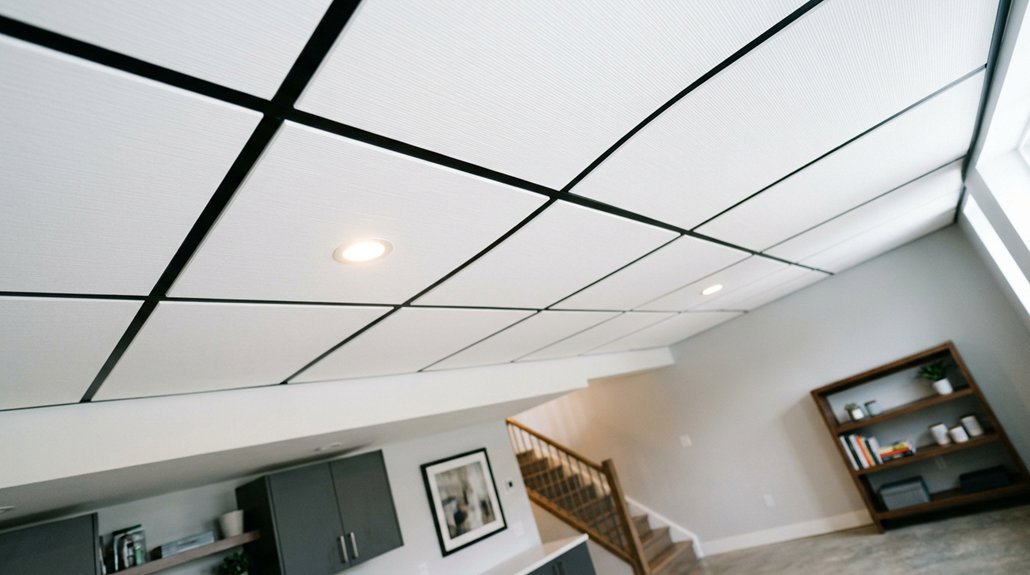
Finishing your basement ceiling is like choosing the foundation of a hidden world, and you’re looking at anywhere from $1 to $15 per square foot depending on what you prioritize. That gap isn’t arbitrary; it’s driven by headroom constraints, moisture resistance needs, and whether you want quick access to pipes and wiring later. You’ll pay $1 to $3 for exposed or painted surfaces, $2 to $4 for drywall, $3 to $7 for drop ceilings, and $3 to $6 for beadboard, with labor eating up 40 to 60% of most budgets.
The real question isn’t just cost; it’s what happens when your water heater leaks at 2 a.m.
How Much Does a Basement Ceiling Cost in 2025?
Why should you care about basement ceiling costs before picking up a hammer? Because you’ll face choices that shape your space for decades. In 2025, you’re looking at $1 to $15 per square foot, a range that demands smart planning.
Drywall ceilings offer that smooth, finished look you want at $2 to $4 per square foot. They’re paintable, permanent, and surprisingly affordable.
Drywall delivers that polished, paintable finish at just $2 to $4 per square foot—permanent style without breaking the bank.
Drop ceilings run $3 to $7 per square foot, giving you easy access to pipes and wiring through removable tiles. That flexibility costs extra, but you’ll thank yourself during repairs.
Stretch ceilings sit at the premium end, $6 to $15 per square foot, yet they install fast and hide imperfections beautifully. With acoustics, beadboard, and other options filling the gaps, your budget and vision find their match.
What Drives Basement Ceiling Prices Up or Down?
What exactly separates a $2,000 basement ceiling from one that runs $10,000 or more? The answer lies in four interconnected factors you’ll need to weigh carefully.
Your ceiling type sets the baseline. Drywall runs $2 to $4 per square foot, drop ceilings jump to $3 to $7, and premium options like stretch ceilings hit $4 to $15. That’s a 750% spread before you factor in anything else.
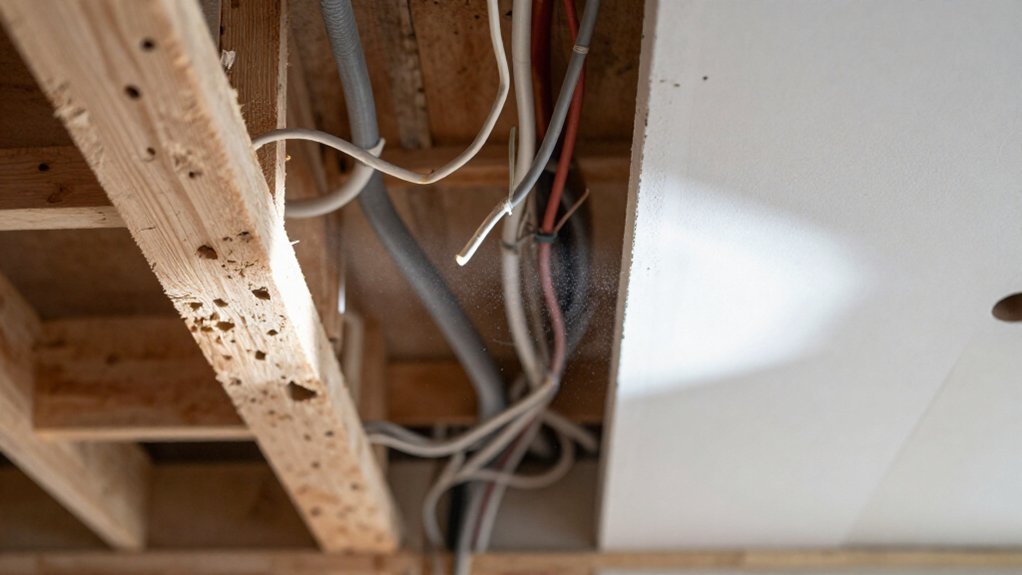
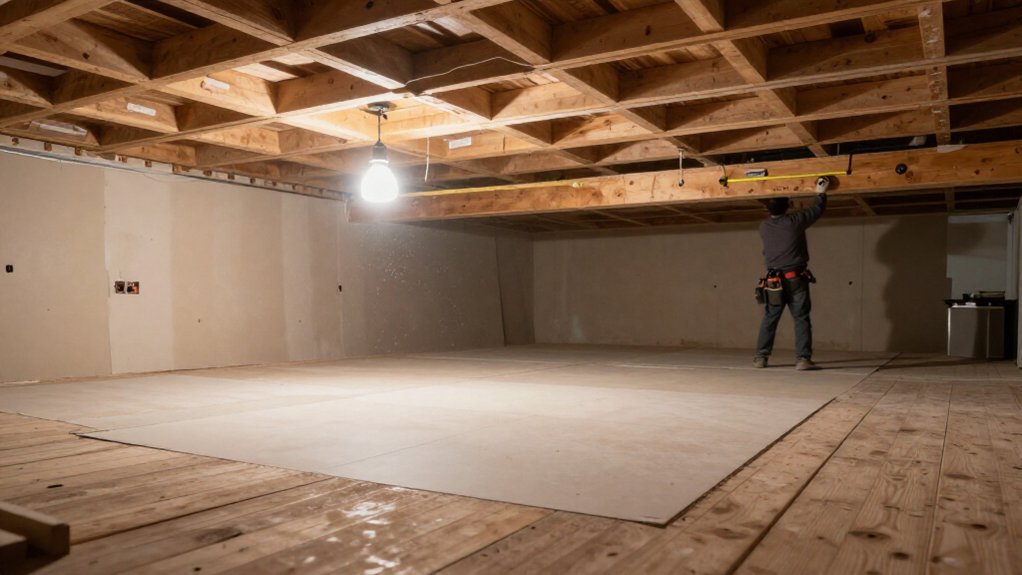
Headroom and access constraints shrink your options fast. Low ceilings or tight utility access force complex framing, special panels, or rerouting HVAC and electrical. Each complication adds hours.
Materials you choose multiply these effects. Basic drywall with paint adds $1 to $6 per square foot, while acoustical tiles or beadboard shift your total dramatically.
Labor costs compound everything. Standalone ceiling projects pay full freight; bundling with larger remodels shares the load, dropping your per-foot price through economies of scale.
What Are You Actually Paying For: Materials or Labor?
You’re paying for both, but the split isn’t always obvious. Drywall runs $2 to $4 per square foot, yet most of that covers labor-intensive taping, mudding, and sanding. Drop ceilings at $3 to $7 per square foot shift costs toward materials because modular tiles install faster. Your material choice directly dictates labor hours, so understanding this balance helps you control the final bill without sacrificing function.
Material Cost Breakdown
Where does your money actually go when you’re staring up at an unfinished basement ceiling, trying to decide between drywall, drop tiles, or something with more character? You’re paying for raw materials first, and the spread is wider than you’d expect.
Drywall ceilings run $2–$4 per square foot, a budget-friendly baseline that delivers smooth, paint-ready surfaces. Drop ceilings cost $3–$7 per square foot, trading some headroom for instant access to pipes and wires overhead. Acoustic/stretch ceilings jump to $4–$15 per square foot, reflecting specialized membranes and tensioning hardware that create smooth, modern planes. Beadboard lands at $3–$6, while exposed joists start dirt-cheap at $1–$3, though finished wood planks climb to $4–$8. Your material choice locks in roughly 40–60% of your total project cost before anyone lifts a tool.
Labor Cost Breakdown
Why does labor often swallow the bigger slice of your basement ceiling budget? Because skilled hands turn raw materials into finished space, and you’re paying for expertise, not just stuff.
Drywall runs $2, $4 per square foot installed, with insulated options demanding even more labor time. Drop ceilings cost $3, $7 per square foot, but that labor cost covers grid assembly and tile placement while preserving access to plumbing and electrical wiring.
Exposed joists cut labor through simpler installation, though upfront framing and finishing still add hours. Access panels require extra work now, yet they prevent costly tear-outs later. Lighting integration drives prices substantially; electrical wiring alone adds $3, $5 per square foot, and fixtures run $75, $500 each. You’re investing in craftsmanship that lasts.
Drywall vs. Drop Ceiling: Which Fits Your Budget and Needs?
You’ll need to weigh three critical factors when choosing between these two ceiling systems, since your selection locks you into very different long-term outcomes. Drywall runs $2–$4 per square foot and gives you that smooth, paint-ready surface, but you’re sacrificing future access to pipes and wires unless you add strategic access panels, which bumps your cost and complexity.
Drop ceilings cost $3–$7 per square foot, immediately solving your utility access headaches with lightweight, removable tiles, though you’ll lose roughly 3–8 inches of headroom, a non-negotiable trade-off in basements where every inch of vertical space already feels precious.
Your best strategy often involves mixing approaches, drywalling finished living zones for aesthetics while dropping the ceiling in mechanical-heavy areas like your utility room, letting you optimize both budget and function without compromising either entirely.
Cost Comparison Breakdown
How do you decide between a smooth, continuous ceiling and one that practically invites you to poke around behind the scenes? You’re weighing ceiling cost against long-term flexibility, and the numbers tell a compelling story. Drywall ceilings run $2–$4 per square foot installed, delivering that smooth, paintable finish you crave, though you’ll sacrifice easy utility access.
Drop ceilings cost more at $3–$7 per square foot, but those removable tiles put your plumbing, wiring, and ductwork within arm’s reach.
Consider these factors when choosing:
- Your total square footage multiplies savings or expenses significantly
- Future maintenance needs could justify higher upfront drop ceiling costs
- Access panels in drywall add expense but preserve that clean look
- Headroom limitations may dictate your decision regardless of price
You can’t ignore the full range either: beadboard hits $3–$6, and overall ceiling cost spans $1–$15 depending on finishes. Your basement deserves a choice that balances your wallet today with your patience tomorrow.
Access vs. Aesthetics
When you’re staring up at exposed joists and ductwork, you’re really deciding between two competing visions for your basement. That choice locks in your relationship with the space for years to come.
Drywall ceilings deliver that smooth, finished look at $2–$4 per square foot, but they seal away your utilities behind a solid barrier. You’ll cut access panels into drywall, sure, yet that patchwork solution never quite matches the original finish.
Drop ceilings run $3–$7 per square foot and flip the script entirely. You pop out tiles whenever plumbing leaks or wiring needs attention; utilities access becomes routine, not demolition.
Access panels bridge both worlds, preserving looks while safeguarding maintenance access. Ask yourself: Do you prioritize pristine appearance, or will you sleep better knowing a water heater valve sits two ceiling tiles away?
Headroom Trade-offs
Where every inch of vertical space matters, you’re forced to weigh what disappears above your head against what stays within easy reach. Drywall ceilings steal 2–3 inches of headroom, sealing utilities behind a smooth, permanent surface. Drop ceilings demand 3–4 inches, but tiles lift away instantly when pipes leak or wires fail.
You’re balancing four competing priorities:
- Cost efficiency: Drywall runs $2 to $4 per sq ft, while drop ceilings hit $3 to $7
- Vertical clearance: Every inch counts in 8-foot basements
- Utility access: Drop ceilings win hands-down for maintenance
- Long-term flexibility: Access panels in drywall offer middle-ground compromise, adding expense but preserving precious headroom
Moisture resistance and light reflectivity favor drop ceilings, though dated aesthetics and replacement tiles nag at your decision. Choose based on how often you’ll crawl back up there.
Are Exposed or Painted Basement Ceilings Cheaper?
What makes exposed or painted basement ceilings such a compelling choice comes down to straightforward economics and practical flexibility. You’ll find both basement ceilings, exposed ceilings, and painted ceilings typically run $1 to $3 cost per sq ft, a fraction of what drywall or drop ceilings demand at $2 to $7+ per sq ft. That’s real savings you can redirect elsewhere.
Exposed joists give you raw industrial character and instant utility access, no panels to remove when pipes leak. Painted ceilings brighten dark spaces, though you’ll touch up more often in damp basements. Neither option steals precious headroom, unlike bulkier alternatives.
Beadboard runs $3 to $6 per sq ft, so you’re paying extra for trim details you may not need. Choose exposed for mechanical transparency, painted for uniform light reflection. Both beat traditional finishes on price and spatial efficiency.
When Is Easy Ceiling Access Worth Paying More For?
Budget-friendly exposed and painted ceilings save you money upfront, but you’ll hit a wall the moment a pipe bursts or your HVAC needs rerouting. That’s when you’ll regret skimping on ceiling access.
Budget-friendly ceilings feel smart until a burst pipe proves otherwise—skimp on access, pay in demolition later.
Investing in accessible designs pays off when your basement houses complex systems. Consider these scenarios:
- Your HVAC requires seasonal filter changes or duct repairs
- Plumbing lines run overhead and aging pipes need monitoring
- Electrical panels or low-voltage wiring demand occasional updates
- You plan future renovations that reroute utilities
Drop ceiling runs $3 to $7 per sq ft, offering instant access to any tile. Drywall with access panels costs $2 to $4 per sq ft base plus $1 to $3 per sq ft for panels, balancing aesthetics with practicality. You’ll spend more now, but you’ll avoid demolition costs later when maintenance calls.
How Should You Budget for a Basement Ceiling Project?
How do you realistically map out basement ceiling costs without drowning in variables? You start by locking in your priorities, because basement ceiling costs swing wildly, from $1 to $15 per square foot depending on materials.
When you’re budgeting, drywall ceilings offer a clean look at $2 to $4 per square foot, but you’ll sacrifice easy access to pipes and wiring. Drop ceilings run $3 to $7 per square foot, and you’ll get removable panels for future repairs. If you’re bundling your ceiling with full basement finishing, you can often negotiate lower rates.
Factor in lighting, headroom constraints, and whether moisture resistance matters. Stretch ceilings cost more upfront at $6 to $15 per square foot, yet install fast. Match your choice to how you’ll use the space, not just today’s price tag.